 FLIP
FLIP How to Play Flip 7
A fast-paced press-your-luck card game for 3–8 players. Free, browser-based, no account needed.
🎯Goal of the Game
Be the first player to reach 200 points across multiple rounds. Each round, you draw cards to build your score — but draw a duplicate number and you bust, losing everything from that round.
The first player to cross 200 wins. Ties trigger a tiebreaker round.
That's the whole rulebook in two sentences, and it's genuinely enough to start playing. But the game gets much more interesting once you understand why those rules produce such agonising decisions — so the rest of this guide walks through the deck, a real round from the browser game, the exact scoring maths, and the handful of strategic ideas that separate a beginner from someone who wins consistently.
🃏The Deck — 94 Cards
Number Cards (79)
The number on each card equals both the points it's worth AND how many copies are in the deck. So there are twelve 12s, eleven 11s, ten 10s … down to one 0.
Action Cards (9)
| Card | Count | Effect |
|---|---|---|
| ❄ Freeze | ×3 | Force an opponent to bank their current round score and exit the round. You can't freeze yourself. |
| ⚡ Flip Three | ×3 | Force any player (yourself included) to draw 3 cards immediately. |
| 🛡 Second Chance | ×3 | Keep as a shield — cancels one duplicate-draw bust if you have it. |
Modifier Cards (6)
| Card | Count | Effect |
|---|---|---|
| +2 / +4 / +6 / +8 / +10 | ×1 each | Flat bonus added to your round score, BEFORE the ×2 multiplier. |
| ×2 Multiplier | ×1 | Doubles your (numbers + flat bonuses) total. The Flip 7 bonus is added AFTER. |
🎮How a Round Works
- Each active player is dealt 1 card face-up at the start of the round.
- On your turn, choose HIT to draw another card or STAY to lock in your current score.
- Drawing a duplicate number means you bust — you lose all points for the round.
- Collect 7 unique numbers in a single round to trigger Flip 7 — a +15 bonus on top of your normal score.
- The round ends when every player has either stayed or busted (or the deck is exhausted, in which case it reshuffles from the discard pile).
👀Your First Round, Step by Step
Rules are easier to absorb when you can see them, so here is an actual round from the browser game, exactly as it plays out. Four players — you (Alex) against three computer opponents. Everyone is dealt one card face-up; you receive a 7.
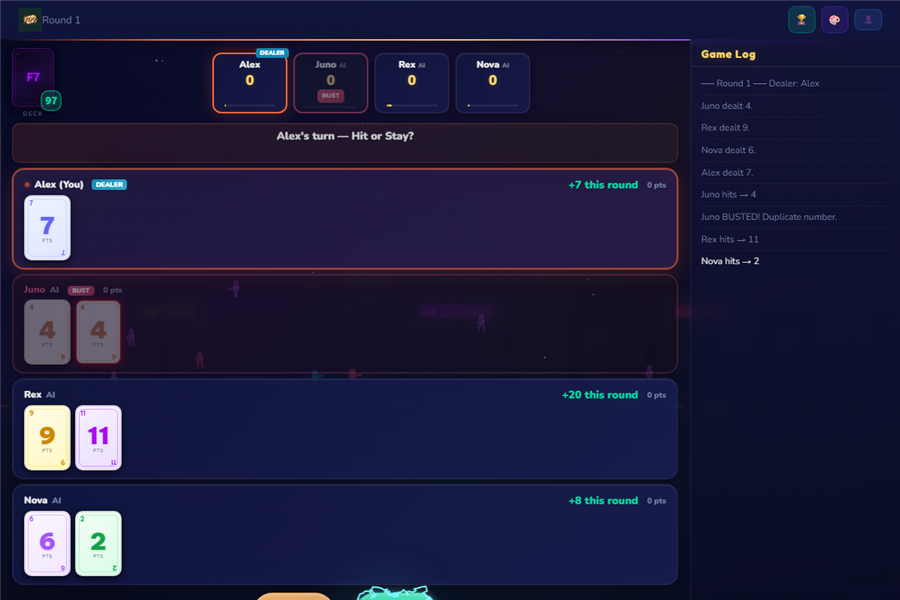
Look at what has already happened. Juno hit on the very first turn, drew a second 4, and busted — the two greyed-out cards and the red badge mean that player scores nothing this round. Rex sits on 9 + 11 for a comfortable 20; Nova holds 6 + 2. Meanwhile your single 7 means your next hit is almost perfectly safe: only six other 7s exist among the ninety-odd cards left, so the bust risk is tiny. This is why experienced players always hit with one or two cards — there is nearly nothing to lose and everything to build.
So you hit, and keep making the same judgement each turn as the row grows. A few turns later the situation looks very different:
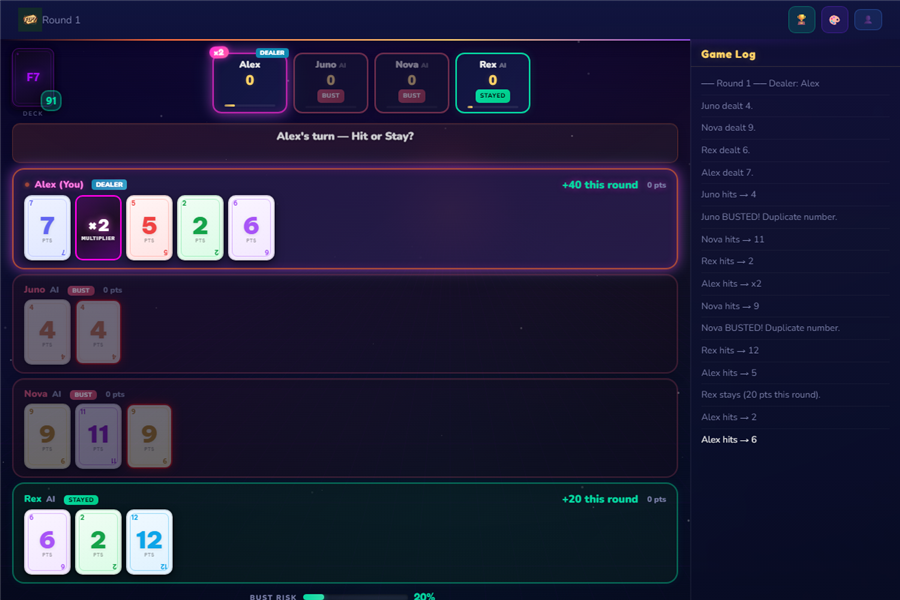
Now the decision is real. Your row is worth 40 points — a very good round — but four of your numbers can now be duplicated, and the meter puts the next hit at a 20% chance of losing all of it. Two opponents have already busted chasing less, and the third banked a safe 20. Stay here, and you take a 20-point lead on the field. Hit twice more, and you're two cards from the +15 Flip 7 bonus on a doubled row. There is no formula that makes this choice for you — that tension is the entire game — but the Odds guide shows you exactly how that 20% figure is computed, and the browser game displays it live under the board on every turn.
📊Scoring
- Base score = sum of your unique number cards.
- Bonus cards (+2, +4, +6, +8, +10) are added BEFORE the multiplier.
- ×2 Multiplier doubles your (numbers + flat bonuses) total.
- Flip 7 bonus = +15 points added AFTER the multiplier.
- If you bust this round, you score 0.
The order of operations matters more than it first appears. Because flat bonuses are added before the ×2, a +10 in a multiplied row is really worth twenty points — while the Flip 7 bonus, added after, is always exactly +15 no matter what else you hold. Worked through fully: suppose you finish a round holding the numbers 3, 5, 9 and 11, plus a +4 bonus and the ×2. Numbers total 28, plus the bonus is 32, doubled is 64. Had that same row also reached seven unique numbers, the Flip 7 bonus would land on top for 79 — not 94, because the +15 is never doubled. Getting this right in your head mid-round is what lets you judge whether one more hit is worth it.
💡Strategy Tips
Want the deeper game — bust odds, which cards are safe to hold, card counting and action-card tactics? Read the full Flip 7 Strategy & FAQ guide.
⌨Keyboard Shortcuts
| Key | Action |
|---|---|
| 1 | Hit (draw a card) |
| 0 | Stay (lock in points) |
| Enter | Next round / Restart |
On mobile: swipe left for Hit, swipe right for Stay.
👥Solo vs. Multiplayer
- Solo: play against 2–7 AI opponents with distinct personalities and risk appetites — some bank early and safe, others chase every bonus and bust spectacularly. The Know Your Opponents guide profiles all eight playstyles.
- Multiplayer: create a room (6-char code), share the invite link with friends, and play live across devices. Server-authoritative — same deck, same draws.
- Stats & achievements: sign in (Google) to save wins, daily streaks, and unlock badges (First Flip 7, beat every AI opponent, 10 wins, etc.). Anonymous play works too — just no cloud sync.
🃏Playing Here vs. the Physical Card Game
This site is a fan-made digital version of the tabletop press-your-luck game, and the rules you've just read are the same ones you'd play at a table. A few things are different simply because a browser can do work that a table can't:
- The maths is done for you. Round scores, multiplier order, and the Flip 7 bonus are computed instantly — no pencil arithmetic, no scoring disputes.
- Bust risk is displayed live. At a physical table, counting which numbers are still "live" is a memory skill. Here the exact percentage sits under the board every turn, which makes the game a surprisingly good trainer for reading odds.
- The deck is dealt by the server in multiplayer. Everyone in a room draws from the same shuffled deck held server-side, so nobody — including the host — can peek or misdeal.
- Turns are paced for you. Dealing, action-card targeting, and round-end scoring animate automatically, which keeps a full table of eight moving quickly.
If you enjoy the game here, the physical card game this is based on is a brilliant thing to own — a browser tab can't replace the table drama of flipping the seventh card in front of friends.