 FLIP
FLIP Flip 7 Glossary
Every term in Flip 7, explained in plain English.
New to Flip 7, or just want a quick refresher on a word you saw at the table? Here is every term the game uses, grouped the way you'll actually meet them: the basic turn first, then the cards, then the action cards that bend the rules, and finally the words that describe how rounds, games, and multiplayer fit together. If you'd rather learn by doing, the How to Play guide covers the same ground as a walkthrough — this page is the reference you come back to.
The basic turn
Everything in Flip 7 hangs on one decision, repeated every turn: take another card, or stop. These five words describe that loop, and if you learn nothing else on this page, learn these.
- Hit
- To draw another card from the deck on your turn. Each hit adds a card to your row and can raise your score — or bust you if it's a duplicate number. Early in a round, hitting is nearly free; with a crowded row, every hit is a genuine gamble.
- Stay
- To stop drawing and bank your current round score. Once you stay, you take no more cards that round and your points are safe. Knowing when to stay is most of Flip 7 strategy — the Strategy guide is essentially one long answer to that question.
- Bust
- Drawing a number card that matches a number already in your row. You lose every point from that round — unless you hold a Second Chance, which cancels the bust. Busting is not a rare accident; it is the game's central threat, and the better players are simply the ones who bust at the right times.
- Row
- The face-up cards in front of you during a round. Your row shows your unique numbers, any modifiers, and determines your risk of busting. A "crowded row" — five or six unique numbers — is both your biggest scoring opportunity and your biggest liability.
- Bank
- To lock in the points you've accumulated this round, either by staying voluntarily or by being frozen. Banked points are added to your game total and can never be lost, no matter what happens later.
Cards & scoring
The 94-card deck has three families — number cards, modifiers, and action cards — and the first two are what your score is made of. The full breakdown, card by card, lives in the Card Guide.
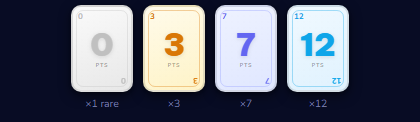
- Number card
- A card valued 0 to 12. Its number is both its point value and how many copies exist in the deck (one 0, one 1, up to twelve 12s). That single design rule creates the whole game: high cards are worth more and more dangerous to hold.
- Flip 7
- Collecting seven unique number cards in a single round. It grants a +15 bonus, added after any multiplier, and is the game's namesake achievement. Pulling one off usually swings the round — and sometimes the game.
- Modifier
- A scoring card: the flat bonuses +2, +4, +6, +8, +10, and the ×2 multiplier. Modifiers can't bust you and don't count toward the seven-unique-numbers Flip 7 target — they simply make the row you already have worth more.
- Multiplier (×2)
- The single ×2 card — there is exactly one in the deck. It doubles your number total plus flat bonuses. The Flip 7 +15 is added after the multiplier and is not doubled. Drawing it changes correct strategy on the spot: every further point you add is suddenly worth two.
The action cards
Nine cards in the deck don't score at all — they let players interfere with each other. Each type appears exactly three times, and each one creates a different kind of decision. The Tips guide covers the classic ways players misuse all three.
- Freeze
- An action card that forces a target opponent to immediately bank their score and leave the round. You can never freeze yourself — it's used to shut down an opponent, and its best target is almost always the leader, right after they've built a big row.
- Flip Three
- An action card that forces a target player to draw three cards in a row, one at a time, resolving each normally. Most dangerous when aimed at a player with a crowded row — three forced draws against six unique numbers is very often a bust.
- Second Chance
- An action card kept in front of you as insurance. It cancels one bust from a duplicate draw — the shield and the duplicate are discarded and you survive in the round (that turn ends). Second Chances stack, so you can hold more than one, each absorbing a separate bust.
Rounds & game structure
A game of Flip 7 is a race to 200 points across as many rounds as it takes. These are the words that describe how that race is organised.
- Round
- One cycle of dealing and drawing. A round ends when every active player has either stayed or busted; a full game spans many rounds — typically five to eight on the way to 200.
- Dealer
- The player the round is dealt around. The seat to the dealer's left receives the first card and acts first; the dealer role rotates one seat every round, so first-move advantage evens out over a game.
- Active player
- A player still in the current round — one who has neither stayed nor busted. Action cards can only target active players, which is why a big banked score is safe but a big unbanked row invites a Freeze.
- Reshuffle
- When the draw pile runs out mid-round, the discard pile is shuffled into a fresh deck and play continues. A reshuffle resets any card counting you were doing — every number is "live" again.
- Tiebreaker
- An extra round played when two or more players are tied at the top after someone crosses 200 points, played until one has a clear lead. Only the tied players take part.
- Press your luck
- The genre Flip 7 belongs to: games built on the choice to keep going for more reward or stop and keep what you have. Also called "push your luck." Blackjack's hit-or-stand is the same idea; Flip 7's twist is that the deck itself tells you the odds, if you're paying attention.
Terms from this version
A few words are specific to playing Flip 7 here in the browser rather than at a physical table.
- Bust risk
- The live percentage shown under the board: the chance that your next hit draws a duplicate of a number already in your row, given the cards left in the deck. It's the same maths the Odds guide teaches — computed for you, every turn.
- Room code
- The six-character code that identifies a private multiplayer room. Share it (or the invite link) and up to eight people can play the same live game, dealt from one shared, server-side deck.
- Hall of Fame
- The global leaderboard of signed-in players, ranked by wins and win rate. Signing in with Google is optional — it exists purely so your stats survive across devices.
- Daily streak
- The count of consecutive calendar days on which you've finished at least one game while signed in. Miss a day and it resets — the little flame in the menu tracks it.
Know the words? Play the game.
One game takes about 5 minutes. No download, no account required.
▶ Play Flip 7 Free