 FLIP
FLIP Flip 7 Card Guide
Every one of the 94 cards in the Flip 7 deck, what it does, and how many exist.
🃏The Deck at a Glance
The Flip 7 deck is 94 cards, split into three families that behave completely differently. Knowing what lives in the deck — and how many of each — is the foundation of every good decision you make at the table.
| Family | Cards | What they do |
|---|---|---|
| Number cards | 79 | Score points; a duplicate busts you. |
| Action cards | 9 | Freeze, Flip Three, Second Chance — change the flow of a round. |
| Modifier cards | 6 | Flat bonuses (+2 to +10) and one ×2 multiplier. |
🔢Number Cards (79)
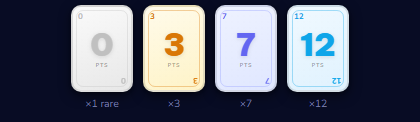
Number cards are the heart of the game. The clever twist is that the number on a card equals both its point value and how many copies exist in the deck. There is exactly one 0 and one 1, two 2s, three 3s… all the way up to twelve 12s.
This single rule shapes the entire game. High numbers are worth more, but because so many copies exist, they are far more likely to reappear and bust you once one is already in your row. Low numbers are worth little, yet they are precious: they are almost impossible to duplicate.
⚡Action Cards (9)
There are three action cards, with three copies of each. They resolve the moment they are drawn. Flip Three can be aimed at any active player, including yourself; Freeze can only target an opponent — never you.
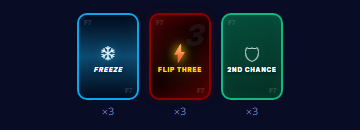
❄ Freeze — 3 copies
Freeze forces a target opponent to immediately bank their current score and leave the round — you can never freeze yourself. It's a purely offensive tool: freeze an opponent right after they build a big row to deny the points they were hoping to grow, or freeze a leader while their score is still low to cut it short. If you're the only active player left, a Freeze is simply wasted.
⚡ Flip Three — 3 copies
Flip Three forces a target to draw three cards in a row, resolving each one normally. Aimed at an opponent who already holds many unique numbers, it is one of the most dangerous cards in the game — three straight draws against a crowded row very often ends in a bust. Aimed at yourself early, when your row is nearly empty, it is a fast and fairly safe way to build toward a Flip 7. If a bust happens mid-draw, the remaining draws are skipped.
🛡 Second Chance — 3 copies
Second Chance is your insurance policy. You keep it in front of you, and the first time you would bust on a duplicate, it cancels the bust — the shield and the duplicate are both discarded, and you survive in the round (that turn ends, but your points are safe). Second Chances stack: hold several and each one absorbs a separate bust. They're most valuable when you're deep in a round with five or six unique numbers and reaching for the Flip 7 bonus, turning a terrifying hit into a nearly free one. Don't waste one on a thin hand.
✖️Modifier Cards (6)
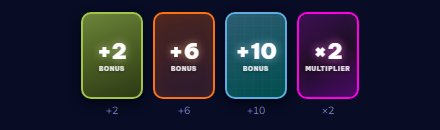
Modifiers don't count toward the seven-unique-numbers Flip 7 target, but they can dramatically inflate a round's score. There is one copy of each.
| Card | Effect |
|---|---|
| +2, +4, +6, +8, +10 | A flat bonus added to your round total, before any multiplier is applied. |
| ×2 Multiplier | Doubles your number cards plus flat bonuses. The Flip 7 +15 bonus is added after and is not doubled. |
Scoring order is what makes modifiers powerful. Because flat bonuses are added before the ×2, a +10 card is effectively worth +20 once the multiplier is on the table. If you already hold the ×2, grabbing bonus cards — and pushing your number total a little higher before you stop — pays double.
🧠Putting It Together
- Number cards decide your risk — the higher they are, the more duplicates are still live against you.
- Action cards are tempo tools: bank safely, force opponents into danger, or buy yourself insurance.
- Modifiers multiply a good round — chase them hardest when a ×2 is already in play.
For when to actually use each card, see the Strategy & FAQ guide, and for the exact bust math behind the number cards, see the Odds & Probability guide.
Know the cards? Prove it.
One game takes about 5 minutes. No download, no account required.
▶ Play Flip 7 Free