 FLIP
FLIP Anatomy of a Flip 7 Round
Every round has three phases — the deal, the build, and the dilemma. Here they are in real screenshots, with the thinking at each moment.
Reading the rules tells you what's legal. It doesn't tell you what a round of Flip 7 feels like — how fast the situation changes, how a table of four becomes a table of one, or what's actually going through a good player's head at the moment the bust-risk meter turns ugly. So this guide does something different: it walks through the three phases every round passes through, using unedited screenshots from real games against the AI. Same board you'll see when you play, same numbers, same decisions.
Phase 1 — The deal, and the first casualty
Every active player is dealt one card face-up, then takes turns hitting or staying. Here's a table of four, seconds after the opening deal:
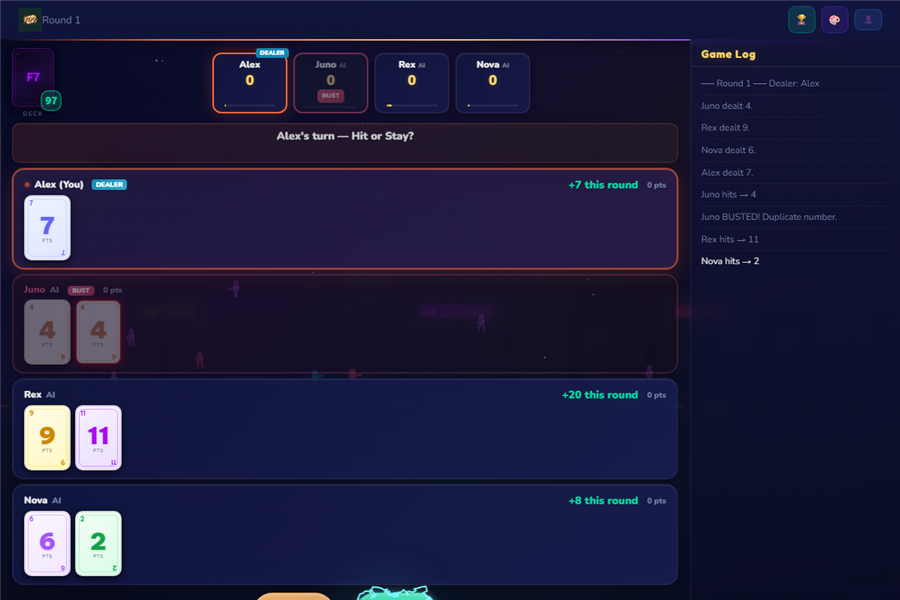
Read the log on the right, because it tells a whole story in six lines. Juno was dealt a 4, hit immediately — a fine decision — and drew the other 4. Busted on the second card of the round: those greyed-out cards and the red badge mean zero points, round over. That's not bad play, just bad luck; with one card in your row the odds are overwhelmingly friendly, and Juno would make the same hit again tomorrow.
Meanwhile the survivors are building. Rex sits on 9 + 11 — twenty points already, but two high numbers means plenty of live duplicates. Nova holds a quieter 6 + 2. And our player, Alex, has a single 7 showing: worth seven points, with only six other 7s among the ninety-seven cards left in the deck. The deck counter in the top-left corner is worth glancing at every turn — it's how card counters keep honest.
Phase 2 — The build
A few turns of good draws later, the same kind of situation has matured into this:
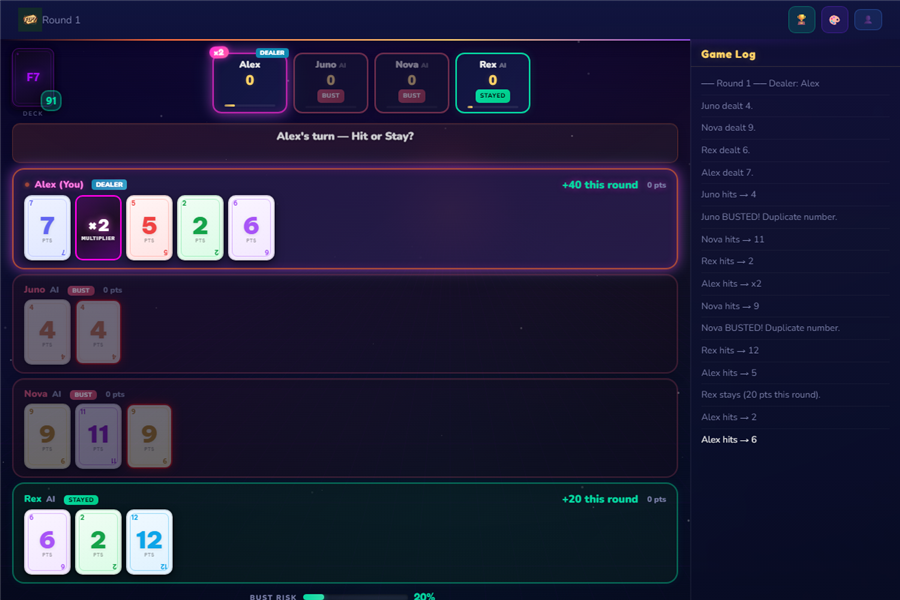
Alex's row is now 7, 5, 2, 6 — four unique numbers totalling 20 — plus the game's only ×2 multiplier, doubling the round to 40 points. Both of the other chasers have busted (Nova drew a second 9 mid-build; the log has the receipts), and Rex banked a safe 20 several turns ago. Alex is the last active player, which means every remaining decision belongs to him alone.
Notice what the multiplier did to the arithmetic of the round. The next number card Alex draws is worth double its face value; so is any bonus card. That's the pull. The push-back is the meter: with 7, 5, 2 and 6 all duplicable, one draw in five now ends the round for nothing. Forty banked points is an excellent round — the question is whether it's greedy or disciplined to want more.
Phase 3 — The dilemma
Here's a row from another real round that pushed two cards further, and this is the moment this game is really about:
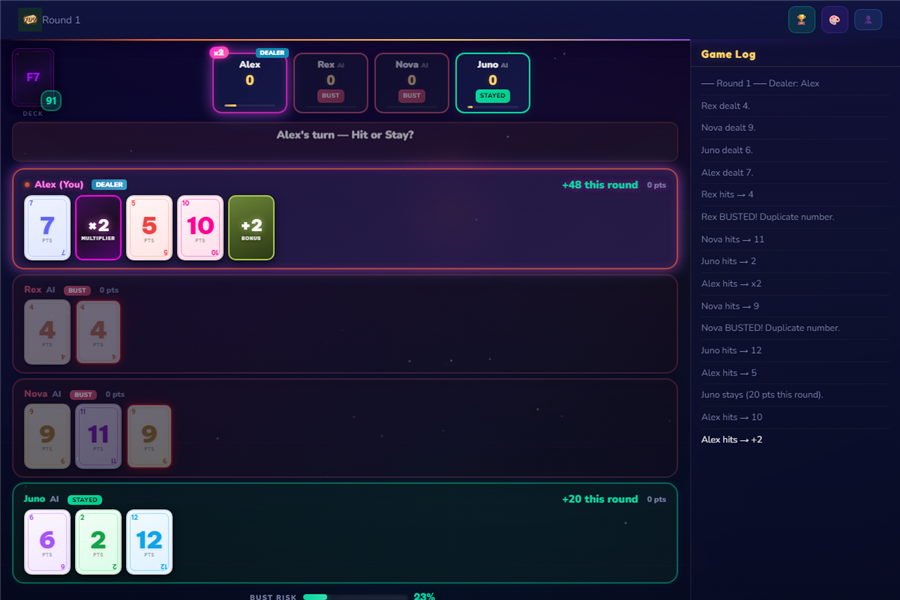
Do the maths the way the game does: numbers 7 + 5 + 10 = 22, plus the +2 bonus card = 24, doubled by the ×2 = 48 points sitting unbanked on the table. The meter says the next hit busts 23% of the time. And there's a third consideration hiding in plain sight: Alex holds four unique numbers, three away from the +15 Flip 7 bonus — far enough that chasing it means surviving three more of these decisions in a row.
What's the right play? Run the honest trade. Hitting risks 48 points to gain, on average, a doubled mid-size card — call it 12–14 points of expected gain against a 23% chance of losing everything. In expected-value terms that's roughly break-even, which means the scoreboard decides: if 48 wins or nearly wins the game, bank instantly; if you're 60 behind a runaway leader, the maths says push. This is why two equally good players can make opposite choices here and both be right — the Strategy guide calls it playing the race, not the round.
How it all ends
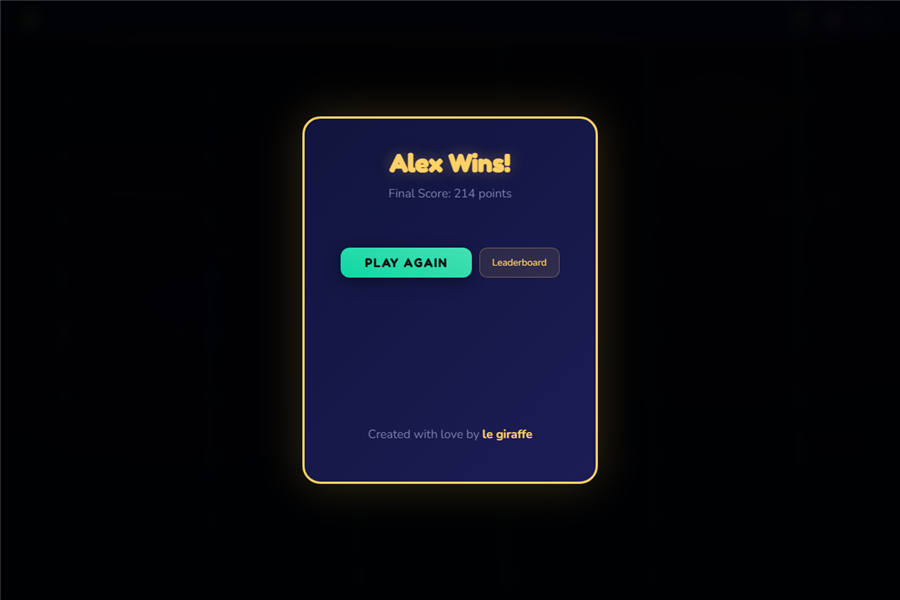
Rounds repeat — deal, build, dilemma — with the dealer rotating each time, until someone crosses 200 points. A typical game takes five to eight rounds and about five minutes. When it's over, the winner gets the confetti:
Three takeaways to carry into your first real game:
- Early hits are close to free. Don't let a turn-one bust like Juno's scare you off the correct play.
- The multiplier changes the round's arithmetic — every card after it counts double, for good and ill.
- Big decisions are scoreboard decisions. The same 48-point row is a snap bank at 180 points and a clear hit at 120.
For the numbers behind every meter reading in these screenshots, the Odds & Probability guide derives them from the deck itself — and the Know Your Opponents guide shows how eight very different AI personalities handle these exact three phases.
Play a round yourself
One game takes about 5 minutes. No download, no account required.
▶ Play Flip 7 Free